
Things to Do in Medellin Without Hurting the City — The Debate Every Traveler Needs to Read in 2026
Things to do in Medellin is one of the most searched travel phrases on the internet today. Rooftop bars in El Poblado, street art tours in Comuna 13, day trips to Guatapé — the content is everywhere, and the city has never been more popular. In 2026, Medellin was named a must-visit destination by National Geographic, welcomed over 1.2 million foreign visitors, and cemented its place as one of Latin America’s top travel hotspots.
But while the travel world celebrates, a very different conversation is happening on the streets of the city itself. On the walls of Provenza — one of Medellin’s trendiest neighborhoods — posters began appearing that stopped locals and foreign residents alike dead in their tracks. The messages were stark and unambiguous: “I’ll trade an Airbnb for a neighbor and a home.” “Medellín is not for sale — stop gentrification.” “Digital nomads, temporary colonizers.”
The woman behind the posters was Ana Maria Valle Villegas, a local resident who had watched her neighborhood change around her at a pace she could no longer accept. She spent a Friday afternoon plastering them across Provenza, sparking a conversation that spread from local Facebook groups to Twitter, to the opinion pages of Colombian newspapers, and eventually to international media outlets including VICE and the BBC.
If you are planning things to do in Medellin in 2026, you need to understand what is happening here before you arrive. This article is the one most travel blogs will never write — because it complicates the story, and complicated stories are harder to monetize. But understanding it will make you a better traveler, and your visit a more meaningful one.
Things to Do in Medellin and the Price Locals Are Paying for the City’s Success
Things to do in Medellin look very different depending on where you stand. If you are a foreign visitor or a digital nomad arriving with dollars or euros in your pocket, the city appears affordable, beautiful, and endlessly welcoming. If you are a local family who has rented the same apartment in Laureles for fifteen years, the city looks increasingly unaffordable — and increasingly unfamiliar.
The numbers tell the story clearly. A study by consultancy firm Breakthrough estimates that around 8,300 digital nomads arrive in Medellin every single month, a flow accelerated by the renewable two-year digital nomad visa Colombia introduced in 2022. This wave of relatively high-earning foreign residents has collided with a housing market that was never built to absorb it. Between 2022 and 2024, rental prices in the El Poblado and Laureles neighborhoods increased by as much as 81%. In a city where the average monthly salary is a fraction of what a North American or European remote worker earns, that increase is not a market adjustment — it is a displacement event.
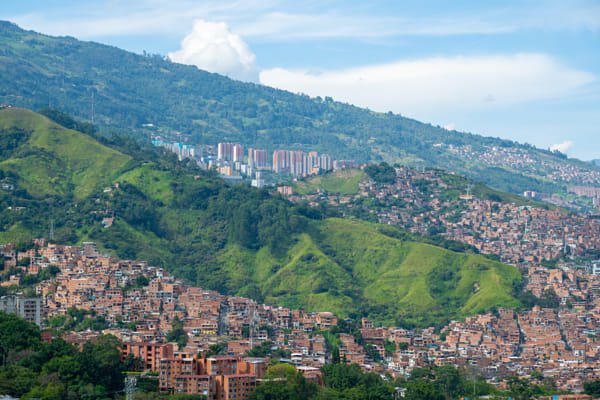
The mechanism is straightforward and well-documented. Landlords across El Poblado, Provenza, and Laureles began cancelling long-term rental agreements with Colombian tenants in order to relist the same properties on Airbnb at three to five times the monthly rate, paid in foreign currency. “I live in a zone where rents have been going up, and we’ve seen renters asked to move out because landlords want to turn their properties into Airbnbs or let them to foreigners for an inflated value,” Ana Maria told VICE. She is not an isolated voice. Across the city, longtime residents describe a Medellin that is becoming unrecognizable — not through violence, as it once was, but through a prosperity that does not include them.
Urban planning expert Professor Juan Guillermo Yunda of Colombia’s Pontifical Javierian University frames the phenomenon precisely: when international digital nomads arrive in significant numbers, the housing market becomes more constrained in ways that displace not the poorest residents, as classic gentrification does, but the middle and upper-middle class families who had built their lives in these neighborhoods over generations. The ripple effects reach downward from there.
Things to Do in Medellin: Understanding Both Sides of the Debate
Things to do in Medellin cannot be evaluated honestly without acknowledging that the foreign visitor economy has also created enormous, documented benefits for many residents of the city. The debate is not simple, and reducing it to a story of villainous foreigners and helpless locals serves no one.
Henry Muriel, an Uber driver in Medellin, is direct about the upside: foreign visitors and digital nomads make up 70% of his business. Their arrival, in his view, is straightforwardly good — more of them means a better economy for drivers, for small shop owners, for street food vendors, for everyone in the informal economy who services the daily needs of mobile, spending visitors. The coffee shop on the corner of Provenza that now has a queue out the door every morning employs eight people from the neighborhood. The tour guide industry in Comuna 13 has created stable income for dozens of young men and women who grew up in the same streets they now lead visitors through.
The question that the city is wrestling with is not whether foreign visitors bring economic benefit — they clearly do. The question is who receives that benefit, and who bears the costs. When a landlord converts a family rental into an Airbnb, the economic gain flows to the property owner. The tenant who is displaced, the neighbor who loses the community they knew, the local restaurant that loses its regular customers because the building is now occupied by a rotating cast of two-week visitors — these people absorb the cost so that someone else can capture the gain.
Medellin’s city authorities are aware of the tension and are actively working to manage it. The Mayor’s Office has initiated measures to monitor irregular lodging practices, particularly the pattern of hosts cancelling confirmed reservations during peak periods in order to relist properties at rates ten to twenty times higher. Local leaders have been explicit about the kind of tourism the city wants to attract: travelers interested in culture, nature, and authentic engagement — not visitors who consume the city’s image without contributing to its community.
Things to Do in Medellin as a Traveler Who Actually Gives a Damn
Things to do in Medellin as a responsible visitor in 2026 do not look dramatically different from any other travel experience. You are still going to visit Comuna 13. You are still going to take the cable car over the valley. You are still going to drink exceptional coffee and eat bandeja paisa and feel, rightly, that you have found one of the great cities of South America.
The difference is in the choices you make around the edges — choices that are small for you and significant for the people who live here year-round.
Where you sleep matters more than you think. Every night you spend in an Airbnb that has replaced a long-term local rental is a night that contributes directly to the displacement economy. Locally-owned boutique hotels and guesthouses run by Colombian families keep money in the community, maintain neighborhood character, and employ local staff with stable income. The price difference, if there is one, is rarely significant for a visitor from a strong-currency country.
Where you eat shapes the economy of the city. The things to do in Medellin that create the most authentic memories — and the most direct economic benefit for local families — happen in the neighborhood restaurants of Laureles, Envigado, and Aranjuez, not in the tourist-facing restaurants of Parque Lleras that have been designed to extract maximum spend from short-stay visitors. The food in the neighborhood spots is better, more honest, and costs a fraction of the price.
Who you book your tours with determines where the money goes. When you visit things to do in Medellin like the Comuna 13 street art tour, the difference between booking with a community-based operator — one whose guides were born in the neighborhood and whose revenue stays there — and booking with a large aggregator platform is not just ethical, it is experiential. The guide who grew up watching the murals being painted on the walls outside his window will tell you something no outsider ever could.
How long you stay reshapes your footprint. The digital nomad who stays in Medellin for three months, learns Spanish, shops at the local market, builds relationships with neighbors, and understands the rhythms of the city has a fundamentally different impact than the visitor who stays for five days, concentrates entirely in El Poblado, and leaves without ever engaging with the city beyond its tourist surface. Things to do in Medellin reveal themselves slowly, to people who are willing to stay long enough to find them.
Where you spend your leisure time signals what you value. Sunday afternoon at a neighborhood fútbol match, an evening at a local salsa bar in Laureles, a morning at the Mercado del Rio buying directly from Colombian producers — these are the things to do in Medellin that exist entirely outside the tourist economy and entirely inside the real city. They cost almost nothing. They give back almost everything.
Things to Do in Medellin With a Conscience: The Traveler’s Checklist for 2026
Things to do in Medellin as a conscious visitor can be summarized in a few clear principles that cost nothing to apply and make a genuine difference to the city you are visiting.
Choose locally-owned accommodation over investor-operated short-term rentals. Book tours with community-based operators who employ guides from the neighborhoods they cover. Eat in local restaurants outside the El Poblado tourist corridor. Spend time in neighborhoods where tourism has not yet homogenized the experience — Envigado, Belén, Aranjuez, and the areas around the Botanic Garden reward the curious visitor with an authenticity that Provenza can no longer offer. Learn enough Spanish to have a real conversation. Tip generously by local standards, not by the standards of wherever you came from. And if you are staying longer than two weeks, rent from a Colombian landlord through a local agency rather than through an international platform that redirects the economic benefit away from the city.
None of these things require sacrifice. They require attention. And attention, it turns out, is exactly what Medellin has always deserved from the world — just not only the kind that comes through a camera lens.
Things to Do in Medellin — The City Is Still Worth Every Moment
Things to do in Medellin remain, despite everything, among the most compelling on the continent. The city’s transformation from the most dangerous urban center in the world to a global destination for culture, innovation, and quality of life is one of the most remarkable stories of the past thirty years. It is real, it is hard-won, and it is worth celebrating.
The gentrification debate does not cancel that story. It complicates it, which is exactly what good stories do. Medellin is a city in the middle of becoming something — it has not finished deciding what. The visitors who arrive in 2026 with curiosity, respect, and a willingness to engage with that complexity are not part of the problem. They are, if they choose to be, part of the solution.
Go to Medellin. Spend your money there. Fall in love with its mountains and its people and its coffee and its extraordinary, improbable energy. But go as a guest — not as a consumer. The city will give you far more in return.
With the June 21 presidential runoff approaching, many travelers are wondering how the election affects their trip — here’s what you need to know.
0 Comment